

Aruna Strengthens Supply Chain and Commitment to Quality Fisheries Products
Jakarta, March 24, 2025 – The global demand for high-quality seafood continues to rise, creating significant economic opportunities for Indonesia. In 2024, Indonesia’s seafood exports exceeded $2.3 billion, making it a key supplier of tuna, blue swimming crab, and other high-value seafood products. As a major player in the fisheries industry, Aruna plays a crucial role in meeting this demand by ensuring a sustainable supply of premium seafood. With operations covering nearly 90% of Indonesia’s coastal areas and partnerships with 55,000 fishers, Aruna connects local producers to international markets, fostering sustainable trade and economic growth.
Entering its 9th year, Aruna is more confident in navigating industry challenges by integrating a strong supply chain and maintaining a firm commitment to product quality. With the spirit of Growing Stronger and Thriving Together, Aruna continues to strengthen Indonesia’s fisheries ecosystem through innovation, adaptive strategies, and close collaboration with strategic partners, fishers, and employees. This resilience and growth not only ensure business sustainability but also bring broad benefits to coastal communities and the fisheries industry.
Amid market challenges and economic fluctuations, Aruna remains resilient by leveraging technology, innovation, and operational optimization to maintain efficiency and seafood supply stability. As Indonesia’s leading digital fisheries company, Aruna continues to build a stronger and more sustainable fisheries industry.
With the increasing global demand, Aruna is expanding its business by introducing premium seafood products such as Tuna, Blue Swimming Crab, and Lobster to international markets, reinforcing its position as a leader in Indonesia’s fisheries sector. Over the past nine years, Aruna has recorded significant business growth, increasing fishers’ income by 3–4 times. Advanced technology enables more accurate supply and demand analysis, driving export expansion by up to 62%. Key products such as Tuna, Blue Swimming Crab, Mackerel, Lobster, and Skipjack are now more widely accepted in global markets, strengthening Indonesia’s export competitiveness.
Farid Naufal Aslam, Co-Founder & CEO of Aruna, expressed gratitude to 55,000 fishers, key buyers, and investors for their support in Aruna’s growth. We are committed to continuously expanding our market and increasing production capacity to meet the ever-growing global demand.
Aruna’s commitment to Growing Stronger and Thriving Together is also reflected in its impact on coastal communities. Aruna’s business not only strengthens the fisheries industry but also creates over 7,000 jobs, 90% of which are filled by women. By establishing an efficient supply chain, empowering fishers, and creating economic opportunities for coastal communities, Aruna ensures that the entire fisheries ecosystem grows together.
Utari Octavianty, Co-Founder & Chief Sustainability Officer of Aruna, added, A growing business must contribute to the well-being of its community. We not only empower fishers but also enhance the welfare of coastal communities, especially fishers’ wives, by providing training in seafood processing and household financial management.
As part of its Sea for All commitment, Aruna actively contributes to marine ecosystem conservation through various initiatives ; Mariculture Program- Restocking 600 million Blue Swimming Crabs to support sustainable population growth. Aruna Zero Waste Hub – Managing 100,000 kg of production waste to reduce environmental impact. Carbon Emission Reduction Efforts– Planting mangroves in three provinces and conducting coral reef transplantation to restore marine biodiversity.
As it enters its 9th year, Aruna remains optimistic about the future, embracing innovation, transparency, and sustainable growth. Through collaboration with strategic partners and fishers across Indonesia, Aruna is ready to grow stronger, improve the well-being of coastal communities, and deliver premium seafood products to both domestic and global markets.
Together with strategic partners and stakeholders, Aruna continues to grow stronger, bringing Indonesia’s fisheries products to global markets and working towards Indonesia Emas 2045.
#SeaForAll #LautUntukSemua
Navigating Challenges: Aruna’s Commitment to Sustainability in Indonesia’s Fisheries Sector
Recently, the startup ecosystem, particularly in the agriculture sector, has faced significant challenges, affecting investor perceptions and tightening access to capital across the industry, including for companies that continue to operate transparently and responsibly.
Aruna, like many companies in the current economic landscape, have made the difficult decision to adjust our workforce as part of a strategic restructuring to ensure the company’s long-term sustainability.
Although there have been organizational adjustments, Aruna remains committed to transparency and responsible business practices, focusing on increasing productivity by strengthening our operations and exploring strategic opportunities for sustainable business expansion.
Despite these challenges, Aruna’s commitment to empowering coastal communities and maintaining quality in meeting the needs of both domestic and international buyers remains steadfast. As we navigate this fluctuating market and strengthen our position, we continue to innovate within Indonesia’s fisheries sector, adapting to ever-changing conditions and striving to deliver sustainable value.
Farid Naufal Aslam, CEO & Co-Founder of Aruna Indonesia
The Kenyan Ministry Discussed Potential Cooperation for Marine Advancement during A Visit to Aruna
H.E. Hassan A. Joho, the Cabinet Secretary for Mining, Blue Economy, and Maritime Affairs of the Republic of Kenya; Betsy Njagi, the Principal Secretary of the Department of Blue Economy and Fisheries; and their staff, visited Indonesia in mid-October 2024. The visit aimed to explore opportunities for cooperation in various sectors, particularly the blue economy and maritime industries. During the trip, the group visited Aruna on October 16, 2024. H.E. Galma Boru, the Ambassador of Kenya to Indonesia, as well as Ricardo Gita Perkasa and Ratih Y. Kombonglangi from the Africa Directorate of the Ministry of Foreign Affairs, also took part in the visit.
During the meeting, the Kenyan team expressed their interest in exchanging perspectives and experiences with Aruna, particularly regarding existing and future collaboration and investment opportunities. The Kenyan acknowledged that Aruna had established itself as a key player in Indonesia’s fisheries sector. Farid Naufal Aslam, the Co-Founder and CEO of Aruna, along with Elkana Lewerisa, Head of Corporate Affairs, represented the company at the meeting.
The Kenyan representatives noted that Aruna’s business model was relatively new. “The approach emphasizes downstream operations that are integrated with upstream processes. This strategy aims to promote community development across nearly 31 provinces in Indonesia. While it may seem like a simple initiative, it requires significant time and effort to implement. This is what we hope to adopt from Aruna. Additionally, we invite Aruna to explore the fisheries sector in Kenya and to learn about our potential in both marine fisheries and aquaculture,” explained Hassan.
Kenya was committed to deepening the importance of sustainability practices and the economic benefits for coastal communities. According to a report from the United Nations website, the country implemented the Fisheries Management and Development Act of 2016, which regulated illegal, unreported, and unregulated (IUU) fishing while promoting the conservation, management, and development of aquatic resources for the livelihoods of its people. This aligned closely with PERMEN-KP No. 39 of 2019 and reflected Aruna’s perspective. “It is essential to unite our efforts and support one another for the sake of proper and ethical practices in ocean exploration,” Hassan emphasized.
After the meeting, Farid said, “We are honored to host representatives from the Kenyan Blue Economy Department. We are eager to share our experiences in managing fish resources using a socio-economic and environmentally-based approach. Aruna looks forward to the potential for further cooperation between Aruna and Kenya, particularly in fostering mutual growth for coastal communities in both countries.”
Aruna Discusses Digital Fisheries Ecosystem and Coastal Community Empowerment at APEC Forum
Taipei, Taiwan – On October 17, Aruna had the opportunity to attend the Asia-Pacific Economic Cooperation (APEC) Forum. This event, organized by the Industrial Technology Research Institute (ITRI) in collaboration with the APEC Policy Partnership on Science, Technology, and Innovation (APEC PPSTI), took place at the Grand Hyatt in Taipei on October 16-17, 2024. Coming to the forum were experts from several countries, including the United States, Japan, Peru, Thailand, Vietnam, the Philippines, Papua New Guinea, China, and Indonesia — represented by Utari Octavianty, Co-Founder and Chief Sustainability Officer of Aruna.
This forum aims for exchange and cooperation among APEC economies in the application and innovation of smart fishery technologies. By utilizing appropriate fisheries technology, hopefully, the businesses could enhance their production, accumulate digital assets, and address issues in the fisheries supply chain. This fosters digital transformation and creates sustainable value from ocean resources. During the forum, Utari discussed technological innovations that support the digital fisheries ecosystem and highlighted efforts to empower coastal communities, particularly coastal women, to fulfill sustainable development goals.
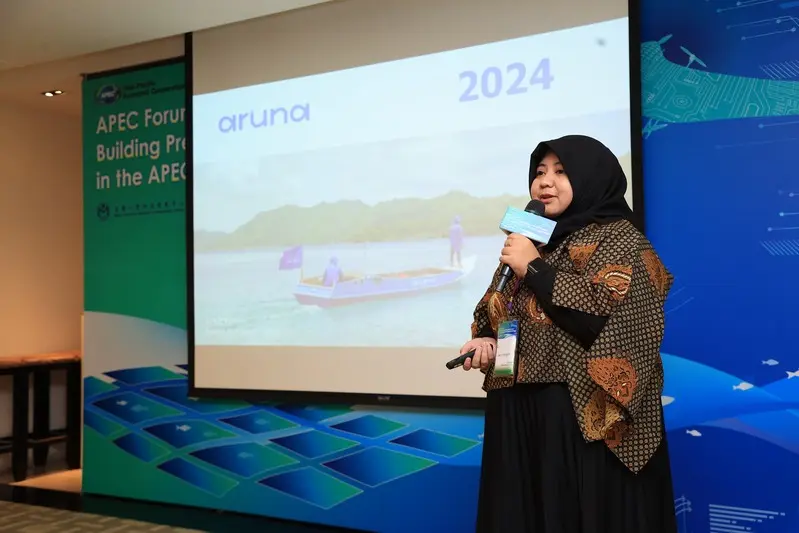
“Aruna is committed to integrating sustainability into our business operations,” Utari explained. “When building a digital ecosystem, it’s essential to ensure that this ecosystem supports sustainable fisheries.” She added that Aruna’s technology enables the projection of market needs, allowing for the development of tailored fishing strategies at each Aruna Hub and ensuring optimal use of fishermen’s catches while minimizing food waste.
Additionally, Aruna actively contributes to the empowerment of coastal women by involving them in post-fishing processing and community leadership. The company provides training in financial literacy, digital marketing, and entrepreneurship, thus empowering micro, small, and medium enterprises (MSMEs). According to Aruna’s 2023 Sustainability Report, over 2000 coastal women have been empowered to manage post-fishing production, with several MSMEs in Banyuwangi (East Java), Bangkalan (East Java), and Muna (Southeast Sulawesi) receiving marketing training.
Striving for an Inclusive Economy, Aruna Wins in Indonesia’s SDGs Actions Awards 2024
PT Aruna Jaya Nuswantara (Aruna) has been recognized for its contribution to building a sustainable economy. This time, Aruna achieved 3rd Place in the Large Company category at Indonesia’s SDGs Actions Awards 2024. The award ceremony occurred on October 7, 2024, at the Fairmont Hotel Ballroom in Jakarta. The award was presented by Vice President (Wapres) K.H. Ma’ruf Amin. Utari Octavianty, Co-Founder and Chief Sustainability Officer of Aruna represented the company at the event.
Vice President K.H. Ma’ruf Amin emphasized the importance of SDGs in his speech, stating, “SDGs are not only about meeting targets but also about creating a fair and sustainable future.”
“We are very grateful for this award, especially in the Large Company category, despite Aruna being a relatively new company, less than 10 years old. The award, later on, recognizes the hard work put in by Indonesian fishers and Nakama Aruna in implementing the Sustainable Development Goals (SDGs) in their processes,” said Utari.
This year’s Indonesia’s SDGs Action Awards theme is the Linkage of Quality Education, Jobs, and Green Industry, focusing on Goal 4: Quality Education, Goal 8: Decent Work and Economic Growth, and Goal 9: Industry, Innovation, and Infrastructure. Aruna advocates for an Inclusive Economy for small-scale fishers through social protection and sustainable fisheries education as good practices for the SDGs, directly contributes to Goal 8, and supports Goal 1: No Poverty, Goal 2: No Hunger, and Goal 14: Marine Ecosystems.
One of the ongoing programs is the Implementation of FIP, where stakeholders work to improve fisheries and management practices to ensure the maintenance of species, habitats, and related communities. Aruna ensures that all stakeholders, including fishers, the government, and the private sector in the value chain, understand the importance of human rights and business ethics in this process. The FIP implementation also aims to enhance the quality of fishers and coastal communities through education and training, creating a safe and healthy work environment, opening up broader market opportunities, and increasing the income of coastal communities by 3-12 times.
Aruna works hand-in-hand with Coastal Community Members to Celebrate the 79th Indonesian Independence Day
South Konawe, Indonesia. To many, independence can mean different things. As most of us know, the spirit of the Indonesian independence day lies in our appreciation towards the heroes of the past who fought tooth and nail to gain independence for our country. However, to Aruna and the coastal communities of Indonesia, the celebration also means keeping up the spirit to improve the welfare and livelihoods of everyone involved.
As such, on August 24-25th, 2024, Aruna hosted a two-day event titled “Aruna Merdeka: Rayakan Semangat Kebersamaan” to commemorate Indonesia’s 79th anniversary of its Independence Day. This event, organized in close collaboration with the local fishers’ community, brought coastal communities across key Aruna locations together to celebrate the spirit of unity and solidarity.
The theme of “Rayakan Semangat Kebersamaan” (Celebrating the Spirit of Togetherness) highlights the strong sense of community that defines Aruna’s network of fishers, pickers, suppliers, and their families. As part of the festivities, this event featured well-known activities such as sack races, boat races, and a culinary competition focused on creating dishes from blue swimming crab (rajungan).
Attending the event were several key figures from both the local community and government, which includes representatives from the Ministry of Marine Affairs and Fisheries, as well as officials from BPJS Ketenagakerjaan. As part of Aruna’s commitment to improving the welfare of the Indonesian Coastal Communities, this event also served as a platform to enhance the work safety of the fishers and their families through the education of BPJS Ketenagakerjaan.
“Nothing says “Indonesian Independence Day celebration like bringing together our community of fishers, suppliers, and other coastal community members,” said Ridwan, one of Aruna’s Regional Managers. “Besides celebrating our national history, this event also fosters a strong sense of unity and collaboration among our coastal communities. Moreover, by bringing relevant partners such as BPJS Ketenagakerjaan, we can implement truly impactful initiatives for these people’s welfare and livelihoods.”
Besides traditional Independence Day competitions, Aruna also invites coastal community members to take part in a Fun Walk, as well as local favorites such as open stage singalongs and community luncheons. Through events like these, Aruna continues to build strong connections with the coastal communities, as well as its fishers, taking yet another decisive step towards creating a stronger, more thriving fisheries ecosystem for Indonesia.
The Climate Crisis and the Balance of Marine Ecosystems: Indonesia’s Role in Combating Climate Change
The climate crisis represents the greatest threat to our planet, with rising global temperatures and extreme weather patterns providing concrete evidence of its escalating impact worldwide. This crisis significantly affects the ocean, a big aspect that is crucial for maintaining ecosystem balance and sustaining life on Earth.
As an archipelagic nation with a maritime area comprising two-thirds of its territory, Indonesia must implement decisive measures to address the climate crisis. In honor of World Oceans Day on June 8, several collaborative initiatives can be undertaken to combat climate change.
The Connection Between the Climate Crisis and Marine Ecosystem Balance
The ocean absorbs approximately 25% of carbon dioxide emissions, playing a crucial role in mitigating global warming by reducing atmospheric carbon dioxide levels. However, an excessive increase in carbon dioxide can lead to ocean acidification, threatening the survival of marine organisms and their ecosystems.
Additionally, rising global temperatures significantly contribute to sea level rise. According to a report from the Intergovernmental Panel on Climate Change (IPCC), global sea levels rose by 0.2 meters between 1901 and 2018. Projections indicate this rise could reach between 0.44 and 0.76 meters by 2100.
Rising sea levels pose a significant threat to human life, with the potential to cause profound social and economic disruptions. These impacts include alterations to coastlines, increased flooding in coastal regions, and the submergence of small islands.
Mitigating the Impact of the Climate Crisis
- Reducing Plastic Waste
According to the United Nations Environment Programme (UNEP), Indonesia generates 3.2 million tons of unmanaged plastic waste annually, with 1.29 million tons ending up in the sea. Without effective management, this plastic waste can degrade seawater quality and harm marine ecosystems.
Utari Octavianty, Co-Founder and Chief Sustainability Officer of Aruna, stated, “Aruna recognizes the government’s commitment to reducing ocean plastic waste by 70% by 2025. However, achieving this goal requires active community support, particularly in reducing the use of single-use plastics. Aruna is advocating for this cause by empowering coastal communities.” - Restoring Marine Ecosystems
Efforts to restore marine ecosystems include mangrove replanting, coral reef restoration, and seagrass protection. These initiatives aim to enhance ocean health and increase carbon sequestration capacity. The Ministry of Maritime Affairs and Fisheries (KKP) has set a target for Indonesia to have marine conservation areas covering at least 30% of its total marine area by 2025. - Choosing Fishery Products from Sustainable Sources
Opting for sustainably sourced fishery products ensures that fishing practices are environmentally responsible. This involves using eco-friendly fishing gear, limiting catches, and protecting essential fish habitats. “It is crucial to ensure our seafood choices come from sources that prioritize sustainability,” said Utari.
Aruna’s Commitment to Combating Climate Change
Aruna is dedicated to actively addressing climate change by:
- Assisting coastal communities in waste management to maintain marine sustainability.
- Conserving marine ecosystems through mangrove planting and restoration.
- Supporting local fishermen in adopting sustainable fishing practices.
By advancing this movement through transformative collaborations, Aruna aims to create not only a healthy blue planet, but also a more just, equitable, and sustainable society. Utari added, “Our dedication is reflected in Aruna’s Sustainability Report, in which our achievements and commitment to maintaining fishery sustainability is documented.
Aruna will persist in innovating and collaborating to protect Indonesia’s seas. We believe that through the collaboration of various stakeholders, we can foster a healthier and more sustainable future for the ocean and the planet.
National Education Day 2024, Aruna’s and Maritime Foundation’s Modest Step to Encourage Coastal Children
DKI Jakarta, Indonesia – “Bergerak Bersama, Lanjutkan Merdeka Belajar” (“Moving Forward, Continuing the System of Free Learning”) was set as the main theme of National Education Day on May 2, 2024 by the Ministry of Education and Culture of the Republic of Indonesia. As written in the National Education Day Commemoration Guidelines, the Ministry of Education and Culture suggested all agencies create fun activities to celebrate National Education Day 2024. This all was to encourage public participation and raise enthusiasm for learning. Aruna and the Maritime Foundation celebrated the big day by giving school equipments and regularly donating books on general knowledge, religion, and fiction, at Aruna’s operational points.
Meanwhile, the locations where Aruna donated the school equipment and books were spread all around the country, from Aceh, Lampung, Central Java, East Java, South Kalimantan, East Kalimantan, South Sulawesi, Southeast Sulawesi, North Maluku, to Papua. This donation aimed to support some of the learning needs of more than 500 coastal children who came from economically disadvantaged families. Since the ceremonial procession of this agenda was held in Muara Gading Mas Village, Labuhan Maringgai, Lampung, Aruna got the honor to have the attendance of the Village Head, representatives of BPJS TK, and representatives of the local Navy.
Wahyono, the Head of Muara Gading Village, said, “To encourage public involvement in celebrating National Education Day 2024, Aruna and the Maritime Foundation are implementing this agenda in several places, including in our village. This reminds me of the three mottos in our educational system. First, ‘Ing Ngarso Sung Tulodo’, which means: ‘Up front, an educator should set an example of commendable action.’ Second, ‘Ing Madyo Mangun Karso’, which means: ‘Among students, teachers should be able to give ideas.’ Third, ‘Tut Wuri Handayani’, which means: ‘A teacher should be able to provide support and direction.’ Well, this third point is manifested through an initiation like this. It doesn’t have to be a big step to give a real positive impact.”
Fisher and coastal community regenerations were a paramount necessity as well as a strategic step to answer future challenges. In Papua, for example, there were only 36.1% of grade 3 elementary school students having adequate literacy skills. This makes Aruna even more convinced that real support for the literacy of coastal children was something crucial to give. They were perceived to be the major successors that would keep their parents’ work as fishers on going. They were believed to bring further blockbust the industry.
Utari Octavianty, the Co-Founder and Chief Sustainability Officer (CSO) of Aruna, affirmed, “Who will take care of our oceans in the future if not coastal children? With simple, concrete steps, let’s prepare them to become the ultimate successors who will also manage our oceans in a much better way. In the future, they are indeed required to understand the concept of sustainability and other things that are more practical. However, this all shall start with their literacy skills. At their current age, by providing support through simple things like this, it is expected that they can have more willingness to learn, as well as to find out about good things they don’t know yet.”
Aruna’s Vast Supply Power, the Opportunity for Its Business Existence
In its eighth year of contribution to the welfare of fishers and coastal communities in Indonesia, Aruna’s consistency to enhance Indonesia’s fisheries and marine sector kept on going. A statement from the Minister of Marine Affairs and Fisheries (KKP) Wahyu Sakti Trenggono at the Indonesia Marine and Fisheries Business Forum 2024 mentioned that the global seafood market was projected to grow up to 8.92%. This growth certainly created promising opportunities for the industry, including the business people working in the realm.
Aruna perceived the calculation as an attractive opportunity to further expand Aruna’s seafood market share by delivering richer commodity variants for global demands. Strengthened by the number of the members onboard reaching more than 55,000 fishers, as well as its supply points covering 150 hubs all across Indonesia, Aruna felt optimistic that it could broaden up its business coverage not only in global markets, but also domestic ones. Having Aruna’s high-rank seafood commodities, such as tuna, crab, lobster, and other commodities, Aruna was well-assured to explore further to Europe, Japan, and the Middle East.
Farid Naufal Aslam, the CEO & Co-Founder of Aruna said, “We see that data from the Global Seafood Market delivered by the Minister of MMAF is an attractive potential for Indonesia to be able to advance the fisheries sector. We will also contribute to making this happen. Aruna is optimistic to be able to create opportunities and markets for local seafood in the global market, this is evidenced by our supply strength that reaches 90% of provinces in Indonesia. Hopefully, Indonesian seafood can be increasingly known to the world and also local seafood export opportunities will also increase.”
In addition, reflecting on the success of other countries in this industrial sector, it is necessary to realize that technology plays an important role to be able to become a “champion” in this industry. Digitalization and data management are 2 basic things that are the key to success for the Indonesian fisheries industry in particular. This is in line with the SEA for All Commitment 2030 that Aruna launched some time ago, one of which is in the implementation of traceability of fishery products. Traceability technology developed by Aruna, one of which serves to monitor the location of product capture areas. Meanwhile, in the internal business, Aruna also has a season calendar that serves to see the trend of the harvest season for a fishery product commodity.
“In our new age, of course, business improvement continues to be carried out, the technology we develop also certainly aims to improve or expand the business and improve the welfare of Aruna fishermen. What we build and implement, certainly has an impact on our fishermen, this is evidenced by the number of fishermen who continue to grow significantly from year to year,” concluded Farid Naufal Aslam, CEO & Co Founder of Aruna.
Aruna as SDG Certified Leader, Advocating the Concept of Aruna Fish Nutrition Zero Waste
Aruna’s efforts to realize the SEA for All Commitment 2030 included participation in the SDG leadership certification program organized by SDG Academy Indonesia and Tanoto Foundation, supported by UNDP Indonesia, Bappenas, Nippon Closure Co Japan, and ICMG Japan Aruna. Represented by Aruna’s Sustainability Supervisor, she participated in the fifth batch of SDG training from October 2023 to March 2024 and finally received the SDG Certified Leader title.
This SDG training focused on leadership programs in the specific aspect of Circular Economy. This SDG leadership program also trained participants to understand sustainability issues based on UN SDGs guidelines. During the program, participants were trained in critical thinking, sustainable business models, and leadership skills.
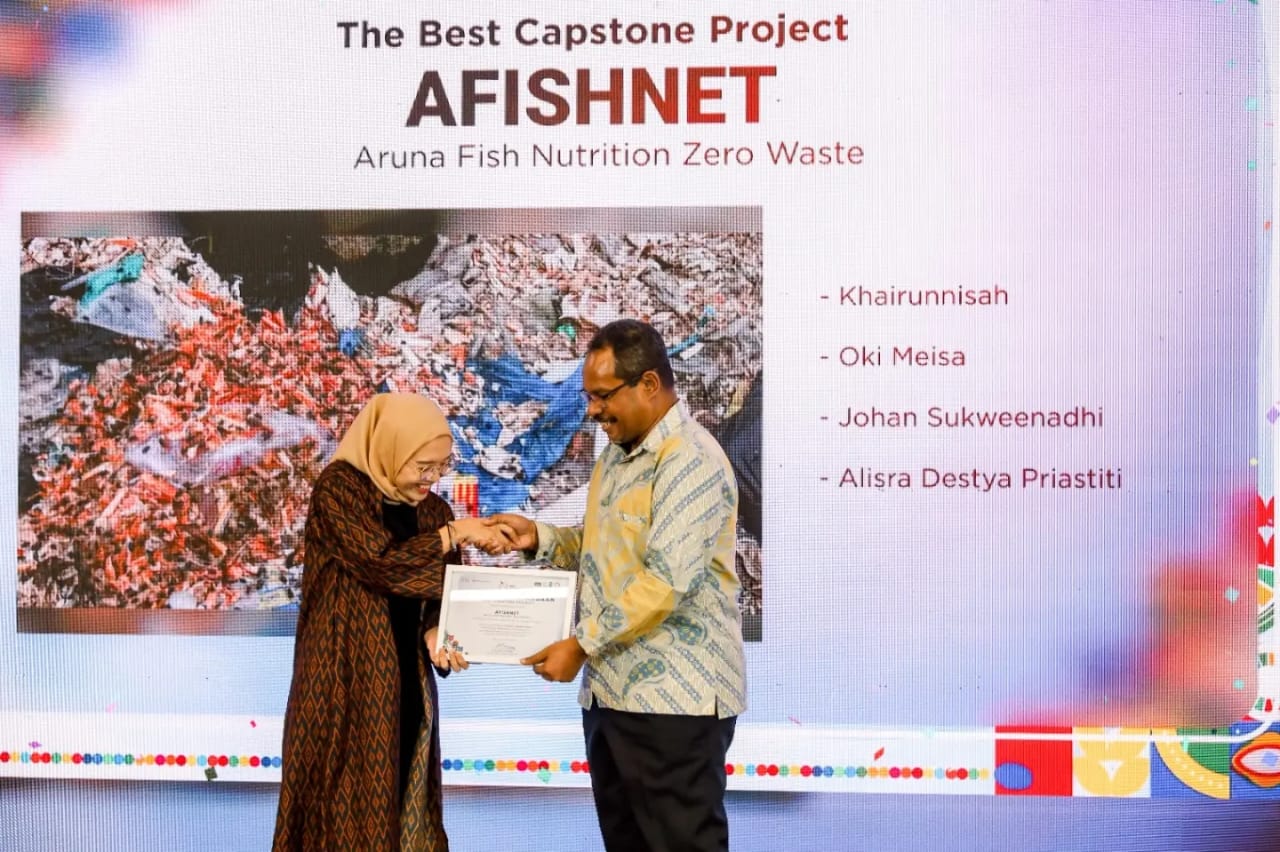
Program participants were required to create a group capstone project with a focus on Management and Waste Processing Technology. Participants were divided into several groups, and Aruna, along with the University of Surabaya, the Central Statistics Agency, and the University of Andalas, developed a capstone project called AFISHNET (Aruna Fish Nutrition Zero Waste). This project focused on processing waste from crab shells and also on technologies that could support environmentally friendly and odor-resistant packaging. In this program, the AFISHNET capstone project won the Best Capstone Project category.
Utari Octavianty, the Co-Founder & Chief Sustainability Officer of Aruna, stated that this activity was part of Aruna’s learning program to develop Nakama Aruna’s (how Aruna employees are called) skills and knowledge, particularly in the aspect of sustainability. She said, “It is expected that it can inspire other employees to go far beyond. There are still many other topics that all of our employees can participate in, and we will fully support them.”