

Rumpon, the “Home” for Fish that Helps Fishermen Practice Sustainable Fishing
Fisheries are one of Indonesia’s key sectors that contribute significantly to the economy. The sector also plays an important role in improving the welfare of communities, especially in coastal areas. Therefore, efforts are needed to ensure the sustainability of the ocean so that the fisheries sector can continue to develop and be beneficial.
One of the efforts to protect the marine environment is to promote the use of environmentally friendly fishing gear. The Provincial Government of South Sulawesi (Sulsel), for example, has a program to build rumpon or fish houses. What are the impacts of the rumpon building program? To find out more, let’s read this article!
Rumpon: Environmentally Friendly Fishing Gear
Rumpon or fish houses are structures that are placed on the seabed or other waters. Rumpon serves as a shelter, gathering place, and breeding ground for fish and marine life.
The advantages of rumpon as an environmentally friendly fishing gear are:
- It does not damage marine habitats and ecosystems. Rumpon can actually help preserve and enrich marine biodiversity.
- It does not produce waste or pollution because rumpon does not use chemicals or toxins that can harm fish and the environment.
- It does not have the potential to overfish, thus protecting small fish and other protected marine life.
By using rumpon, fishermen can catch fish more easily and efficiently. Fish will gather around the rumpon, so fishermen do not need to search for far or uncertain fishing locations. Fishermen only need to approach the rumpon and catch the fish that enter it. This can save operational costs and increase catch.
Rumpon Construction for Fishermen
Given the positive impacts of rumpon construction, the Sulsel Provincial Government plans to build rumpon on a massive scale. Rumpon construction is one of the priority programs of the Provincial Government that is considered strategic to support the fisheries sector in the Sulsel region.
According to the Head of the Sulsel Fisheries and Marine Affairs Office, M. Ilyas, the Sulsel Provincial Government has allocated a budget of Rp 109 billion for the construction of 68,280 units of rumpon for fishermen in 19 regencies/cities. This budget is taken from the 2024 Regional Revenue and Expenditure Budget (APBD) that is specifically for the fisheries sector.
Diversification of Fisheries Programs
In addition to rumpon construction, the Sulsel Provincial Government has also allocated a budget for other programs, namely an insurance program for 10,000 fishermen, the restoration of facilities and infrastructure in six fishing ports, and supervision in the field of fisheries and marine affairs.
These programs are expected to support the development of the fisheries sector in Sulsel in a comprehensive manner, both from the production, distribution, and consumption sides. Thus, it is hoped that it can provide broad benefits for the people of Sulsel, including reducing poverty, ensuring food availability, and preventing stunting.
Through the rumpon construction program and various other initiatives, it is hoped that Sulsel can become an example for other regions in efforts to preserve the marine environment, while also improving the welfare of coastal communities.
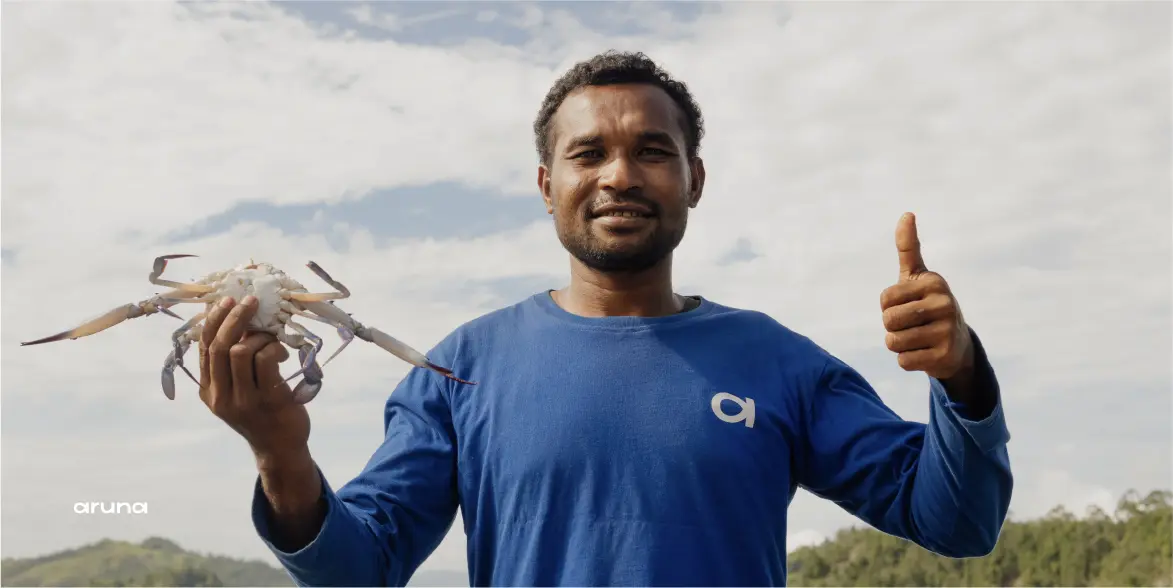
Aruna, a fishing company that is committed to the sustainability of marine and fisheries resources, also supports the program to use environmentally friendly fishing gear. In its implementation, Aruna fishermen also use environmentally friendly fishing gear, for example, traps used to catch crabs. This shows Aruna’s commitment to maintaining the balance of the marine ecosystem.
Let’s all support programs that can preserve the marine environment. With the support of all parties, we can create a sustainable ocean with all its biodiversity.
Aruna’s Fisher Products Shine as Prime Fisheries Supply in America
In North America, the Seafood Expo North America (SENA) stands as the largest seafood exhibition. Thousands of stakeholders in the fisheries supply chain, including buyers and suppliers, gather for this three-day annual event. North America itself is a significant importer of various seafood products from around the world. At SENA, Aruna Crab, a premium crab product produced to meet global sustainability standards, took the spotlight, capturing the attention of attending buyers.
Aruna has been present in the North American market since 2017 and continues to thrive due to ongoing import demands. One of the key factors contributing to Aruna’s success in maintaining its position in the global fisheries supply chain is its commitment to delivering top-quality seafood products. International consumers now pay close attention to aspects like traceability, sustainable fisheries, and Good Manufacturing Practices (GMP) for every product entering their seafood supply chain.
Aruna Assists the Government in Global Fishery Product Marketing
The Indonesian government, through the Ministry of Maritime Affairs and Fisheries, is actively promoting the export of fisheries products. They have targeted five fisheries product commodities to achieve global recognition: shrimp, lobster, crab, seaweed, and tilapia. As an integrated fisheries commerce and supply chain aggregator from Indonesia, Aruna has contributed to the Indonesian government’s goal by supplying three key commodities – crab, shrimp, and fish – for global fisheries supply, especially to America.
Aruna Focuses on Meeting International Fisheries Supply Demands with Globally Standardized Quality Products
Utari Octavianty, Co-Founder and Chief Sustainability Officer of Aruna, stated that Aruna’s products have been present in international markets, with a focus on different commodities for each country. For example, Aruna’s crab has gained recognition for its quality among American consumers, and Aruna consistently meets their demand for this product. Furthermore, other premium commodities from Aruna have also found favor with international consumers. To date, Aruna has produced over 23 premium fisheries products with international quality standards, catering to both domestic and international seafood retail consumers who can enjoy these high-quality Aruna products through the Seafood by Aruna e-commerce platform.
Up to this point, Aruna and the Aruna Hub ecosystem have grown alongside 40,000 Aruna fishermen and 500 coastal women, producing fisheries products that meet the highest Global Food Safety standards, making Aruna’s products suitable for international markets. Moreover, the government has taken steps to advance the fishery product downstream processing to boost the maritime economy. With the growth achieved so far, Aruna is increasingly optimistic about helping the Indonesian government internationalize its fishery products.
The Importance of Marine Resource Balance in Implementing Sustainable Fishing
Located in Panama, on Friday, March 3, 2023, an international event called the Global Ocean Accounts Partnership (GOAP) Side Event at the Our Ocean Conference (OOC) has just concluded. Victor Gustaaf Manopo, the Director-General of Marine Spatial Management representing the Government of Indonesia, specifically the Ministry of Maritime Affairs and Fisheries (MMAF), played an active role in this event by emphasizing the significance of ocean resource accounts in addressing the challenges of sustainable fishing management aligned with the blue economy direction.
Since 2021, a pilot project on marine resource accounts has been conducted in 7 Marine Conservation Areas (MCAs) and 1 fisheries region, establishing a strong foundation for Indonesia in determining the extent of ecosystems, conditions, and monetary values for mangroves, coral reefs, and seagrasses on a national scale. Victor revealed this development.
The Reasons Why Marine Resource Balance Matters in the Blue Economy and Sustainable Fishing
The definition of marine resource balance (MRB), according to the MMAF, is a structured and consistent compilation of information, including maps, data, statistics, and indicators about the marine and coastal environment, including social conditions and economic activities related to the seafood supply chain. MMAF has collaborated with GOAP on a pilot project to develop and compile MRB. The ministry, led by Sakti Wahyu Trenggono, views MRB as an ideal reference for implementing marine management that takes into account marine resource assets, economic flows, and the environment, which are closely linked to sustainable fishing.
MRB as an Instrument with National and Global Implications

Victor explained that the challenges of sustainable marine management lie in three aspects: protecting the ocean while maintaining its benefits for humanity, striving for increased ocean protection while considering economic aspects, and ensuring that goods and services from the ocean benefit all parties.
MMAF positions MRB as an instrument that should be involved to assist in the management of conservation areas, marine spatial planning, coastal ecosystem rehabilitation, and marine-based economic development. Considering its national and global policy implications, the Indonesian government prioritizes the development of MRB as something important and urgent. The national and global implications can be outlined as follows:
National Implications:
Providing data and information on biodiversity and ecosystems for national development that supports the achievement of Sustainable Development Goals (SDGs).
Global Implications:
Urgently contributing to Indonesia’s commitments in forums such as the Convention on Biological Diversity (CBD) and the High-Level Panel on Sustainable Ocean Economy (HLP-SOE).
Attended by Many Stakeholders, Indonesia Seizes Its Presence at OOC 2023
The Our Ocean Conference 2023 was attended by representatives from various countries, including Mike Kelloway, Chairman of the GOAP Council; Rick Spinrad, Deputy Administrator of NOAA (United States); Ilana Seid, Permanent Representative of Palau to the United Nations; Palau’s Ocean Panel Sherpa; Per W. Schive, Deputy Director-General of the Ministry of Climate and Environment (Norway); and Ilona Drewry, Head of International Sustainable Blue Finance (United Kingdom). Given that this international forum is a crucial platform for formulating various aspects for the success of the blue economy, it is highly appropriate to reiterate the significance of MRB, which was initiated by Minister Trenggono.
By actively participating in international forums related to SDGs and sustainable fisheries, the role of the Indonesian government will gain respect from other nations. Similarly, Aruna, representing the fishing companies in Indonesia, has consistently advocated for the betterment of national and global communities on various occasions. To advance the fisheries industry successfully, appropriate methods and instruments that preserve ecology must be employed. In the future, Aruna also envisions representing the national fisheries and marine ecosystem on the international stage.
The Importance of Sustainable Fishing in Combating Global Warming
The melting of ice in Antarctica has now reached a concerning stage. Even the largest iceberg known as A68A has melted about 1 trillion tons or 900 million metric tons. This amount of water could fill an Olympic-sized swimming pool over 60 million times. So, what can we do to address this global warming challenge? From the perspective of fisheries, we must increasingly focus on preventing environmental damage by prioritizing the implementation of sustainable fishing methods.
Why is Sustainable Fishing Important?
The current state of nature is deeply worrisome. Fortunately, more and more people are becoming concerned about environmental sustainability. Even in developed countries, sustainable certification is becoming a requirement for various consumer products. Looking back a bit, the term “sustainable” implies continuity and persistence. In this context, sustainability refers to the preservation of the environment.
In the past, many production and consumption methods contributed to environmental degradation. Thus, the adoption of sustainable methods in various production and consumption processes is deemed crucial because it already considers environmental preservation. Moreover, the more individuals and parties are involved in environmental conservation, the faster the recovery of the natural world can occur. Consequently, implementing procedures that prioritize environmental sustainability from the production process onward is highly imperative.
Coastal Communities as Frontline Guardians
The majority of economic activities in the fisheries sector are supported by communities residing in coastal areas, as most of them earn a living as fishermen. This is why coastal communities must be thoroughly educated about the application of sustainable fisheries. Aruna, a fisheries-focused startup deeply committed to environmental issues, designates these coastal communities as frontline guardians. Notably, non-coastal communities also contribute significantly as fish cultivators and processors.
By then, both countries have formed the Canada-Indonesia Comprehensive Economic Partnership Agreement (CEPA), where they not only aim to establish mutually beneficial trade relationships for the long run but also promote environmental sustainability and improve management systems for greater impacts.
Consumer Role in Sustainability
Is the effort to preserve the environment only sufficient during the production phase? Of course not. As mentioned earlier, consumers also play an equally important role in environmental preservation. If various aspects of life increasingly prioritize sustainability, the positive impacts will undoubtedly multiply.
Consumers’ growing awareness of environmental issues has given rise to the concept of a sustainable lifestyle. This lifestyle emphasizes the conservation of the environment by ensuring that the products they use and consume are processed with environmental considerations in mind. This encompasses everything from building materials, utensils, and clothing, to food. It’s even possible that in the future, there will be seafood suppliers exclusively offering sustainable products.
With more public figures endorsing the sustainable lifestyle, more members of the general public are being exposed to the concept of sustainability. This on-ground reality leads the Aruna team to earnestly hope that more individuals will get involved in preserving the environment. With increased participation, the resulting impacts can be more easily felt by the society at large.